


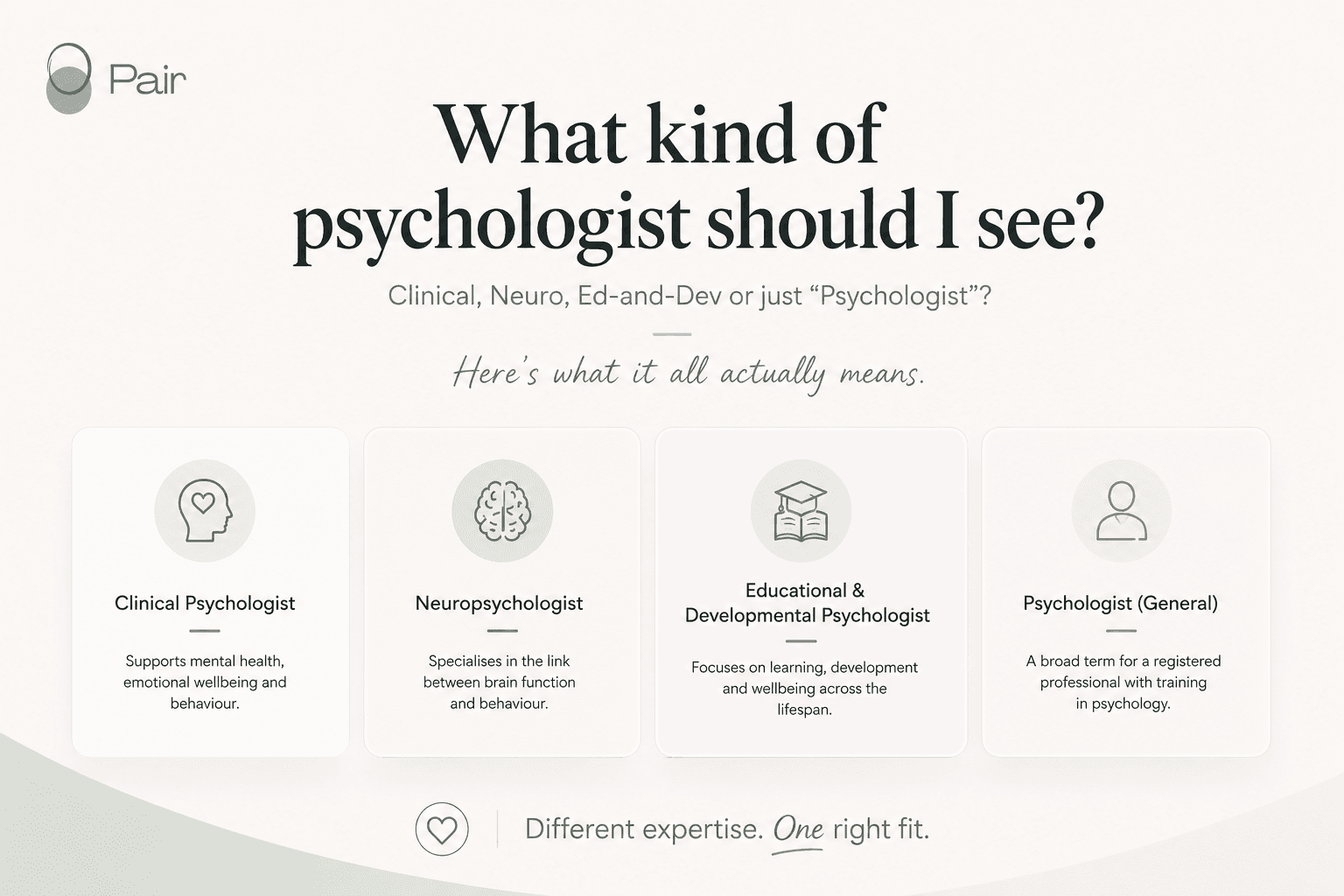
What kind of Psychologist Should I See? Clincial, Neuro, Ed-and-Dev or just "Psychologist"?
Making the decision to seek mental health support is the first step in taking ownership of your wellbeing. But then you start Googling and suddenly you're drowning in titles like Clinical Psychologist, Clinical Neuropsychologist, Educational and Developmental Psychologist and Generally Registered Psychologist. What do they all mean, why are there so many, and most importantly, which one should you see? These questions can feel overwhelming if you aren't well-versed in the mental healthcare system, so this article will unpack what each one is and what they focus on.
First, what they all have in common
Every single psychologist in Australia, no matter what title sits next to their name, has had to register with AHPRA (the Australian Health Practitioner Regulation Agency). To even call yourself a psychologist here, you need a minimum of six years of training, usually a four-year undergraduate degree in psychology, followed by either a two-year Master's, a PhD, or two years of supervised practice.
After that, some psychologists go on to do extra specialist training in a particular area. That extra training is called an endorsement, and it's why your therapist's title might have an extra word in front of it.
This list isn't exhaustive, there are other endorsements, but here are the ones you're most likely to come across.
The generally registered psychologist (a.k.a. "general" or "registered" psychologist)
This is your broadly-trained psychologist. They've done the full six years and are fully qualified to help you with a wide range of mental health concerns. They just haven't done a clinical endorsement on top.
You'd see one for: anxiety, low mood, stress, burnout, grief, breakups, work stuff, family stuff, or when you're starting to feel a bit overwhelmed, navigating a big life transition, or building healthier coping skills. Basically, the everyday human struggles that don't necessarily come with a complicated diagnosis attached.
The clinical psychologist
A clinical psychologist has completed a clinical endorsement, which means extra specialist training (a Master's or doctorate in clinical psychology, plus a supervised registrar program) focused on assessing, diagnosing and treating mental health conditions.
You'd see one for: more complex or persistent difficulties, or when there's a diagnosis in the mix. Think depression or anxiety that isn't shifting, OCD, PTSD and complex trauma, eating disorders, bipolar, or personality-related difficulties. They tend to work in a structured, evidence-based way, and they're trained to build a clear picture of what's going on and match the treatment to it.
One practical note: clinical psychologists attract a higher Medicare rebate than generally registered psychologists, though they often charge a higher fee too. That said, a general psychologist can help with many of these same concerns, so the title isn't the only thing that matters.
The clinical neuropsychologist
Neuropsychologists focus on the relationship between the brain and how we think, remember and function. Rather than ongoing talk therapy, a lot of their work is detailed cognitive assessment.
You'd see one for: understanding changes in memory, attention, concentration or thinking, often after a stroke or brain injury, or in conditions like dementia or epilepsy. They're also involved in assessing things like ADHD and learning difficulties. If a GP or specialist wants a clear picture of how someone's cognition is working, a neuropsychologist is usually who carries out that assessment.
It's worth knowing they're more assessment- and diagnosis-focused, so if what you're after is regular therapy sessions, one of the other types is probably a better starting point.
The educational and developmental psychologist
These psychologists focus on learning, development and behaviour across the lifespan, though a lot of their work is with children, teenagers and families.
You'd see one for: a child or teen who's struggling at school, learning difficulties, developmental delays, assessments for things like autism or ADHD, behavioural concerns, or support through big developmental stages. They also work with parents, and with adults navigating learning or developmental questions.
If you're a parent trying to work out why school is hard for your child, or you're after a developmental or learning assessment, this is often the right person to start with.
The counselling psychologist
Counselling psychologists have completed a counselling endorsement. Like clinical psychologists, they're trained to work therapeutically across a broad range of emotional and mental health concerns, often with a particular emphasis on the therapeutic relationship, life adjustment and helping people work through distress.
You'd see one for: anxiety, depression, relationship difficulties, grief and loss, self-esteem, identity, life transitions, and working through past experiences. In practice there's a lot of overlap with what clinical psychologists do, and both are common choices for ongoing therapy.
Worth knowing for cost: under Medicare's Better Access scheme, counselling psychologists are rebated at the general registered rate rather than the higher clinical rate, even though they've completed extra training.
The health psychologist
Health psychologists focus on the connection between psychological wellbeing and physical health. They look at how thoughts, behaviours and stress affect the body, and how we cope with illness.
You'd see one for: adjusting to a chronic illness or a difficult diagnosis, managing chronic pain, sleep difficulties, and health-related behaviour change like quitting smoking or building steadier habits. They often work alongside medical teams as part of your broader care.
Other endorsed areas you might come across
The remaining endorsements are more context-specific. You're less likely to seek these out directly for everyday mental health support, but it helps to know what they do:
- Community psychologists work at the level of groups, organisations and communities, focusing on prevention, social wellbeing and issues like disadvantage, rather than one-on-one therapy.
- Forensic psychologists work at the intersection of psychology and the legal system, including assessments, court-related work, and working with people in the justice system.
- Organisational psychologists focus on people at work, in areas like workplace wellbeing, performance, leadership and teams, usually in a business setting rather than a therapy room.
- Sport and exercise psychologists support athletes and active people with the mental side of performance, motivation, and the psychology of exercise.
So which psychologist should you see?
Here's the reassuring part: you don't need to diagnose yourself or get the title exactly right before you reach out. For most everyday concerns, a generally registered or clinical psychologist is a great place to start, and if a different kind of assessment turns out to be needed, they or your GP can point you in the right direction.
What matters more than the title is finding someone with genuine experience in what you're dealing with, who you feel comfortable talking to. If you're not sure where to start, Pair can help you find and get in touch with a psychologist who fits what you need.
.png&w=1920&q=75)