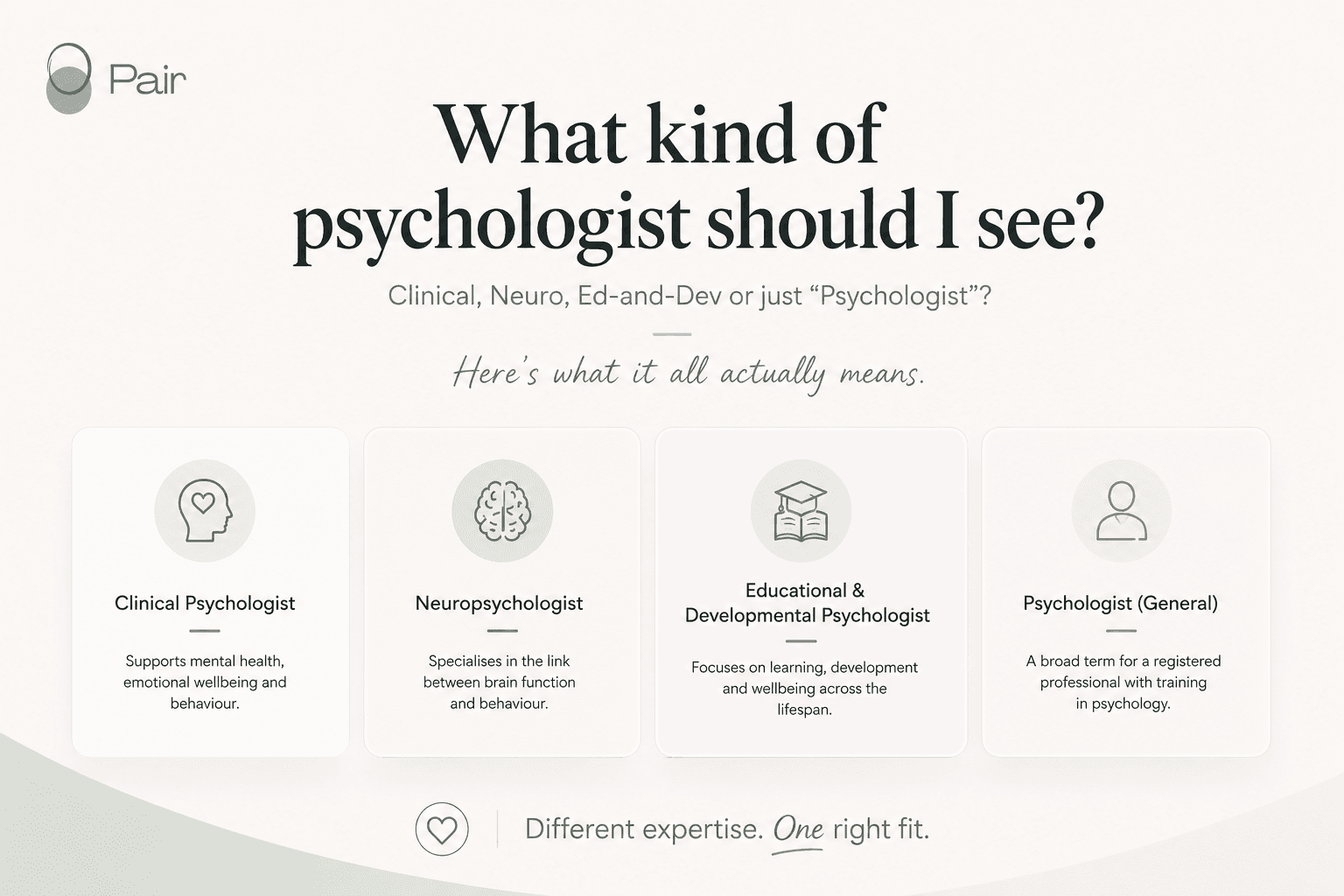
What kind of Psychologist Should I See? Clincial, Neuro, Ed-and-Dev or just "Psychologist"?
Author
Dr Brendan Tan (PhD)
Dr Brendan Tan is CEO and co-founder of Pair. As a former clinician and researcher, he brings deep expertise in psychology, digital health, and evidence-based care innovation.
Making the decision to seek mental health support is the first step in taking ownership of your wellbeing. But then you start Googling and suddenly you are drowning in titles like: Clinical Psychologist, Clinical Neuropsychologist, Educational and Developmental Psychologist and Generally Registered Psychologist. What do they all mean, why are there so many, and most importantly, which one should you see? These questions can feel overwhelming if you aren't well-versed in the mental healthcare system, so this article will unpack what each one is and what they focus on.
Firstly:
Every single psychologist in Australia, no matter what title sits next to their name, has had to register with AHPRA (the Australian Health Practitioner Regulation Agency). To even call yourself a psychologist here, you need a minimum of six years of training (usually a four-year undergrad degree in psychology, followed by either a two-year Master's, a PhD or two years of supervised practice).
After that, some psychologists go on to do extra specialist training in a particular area. That extra training is called an endorsement, and it's why your therapist's title might have an extra word in front of it.
This list is not exhaustive, there are other clinical endorsements, but we have listed the three you might see most commonly.
The Generally Registered Psychologist (a.k.a. "general" or "registered" psychologist)
This is your broadly-trained psychologist. They've done the full six years and are fully qualified to help you with a wide-range of mental health stuff. They just haven't done a clinical endorsement on top.
You'd see one for: anxiety, low mood, stress, burnout, grief, breakups, work stuff, family stuff, or when you are starting to feel a bit overwhelmed, navigating a big life transition, or building healthier coping skills. Basically, the everyday human struggles that don't necessarily come with a complicated diagnosis attached.
Ready to find the right support?
Take our matching quiz to connect with clinicians who understand your needs.
How they work: Lots of them use approaches you've probably heard of such as Cognitive Behavioural Therapy (CBT), Acceptance and Commitment Therapy (ACT), mindfulness, motivational interviewing, and talk therapy. Sessions usually involve conversation rather than formal testing.
Medicare: With a Mental Health Treatment Plan from your GP, you'll get a rebate of around $98.95 per session for up to 10 sessions a year.
The Clinical Psychologist
A Clinical Psychologist has done all of the above, plus a two-year clinical Master's (or PhD) in Clinical Psychology, plus a two-year supervised registrar program. This means eight-plus years of training and a particular focus on diagnosing and treating mental health disorders, including the trickier and more complex presentations.
You'd see one for: anything that feels more layered or persistent. Trauma and PTSD, OCD, eating disorders, borderline personality disorder, bipolar, severe depression that hasn't responded to other treatment, or situations where you're not sure what's going on and want a thorough assessment to figure it out. They're particularly good at case formulation, which is a fancy way of saying they'll piece together the full picture of why you're struggling, not just slap a label on it.
How they work: Beyond CBT and ACT, you'll often see things like Schema Therapy, Dialectical Behaviour Therapy (DBT), EMDR (the eye-movement one for trauma), and Compassion-Focused Therapy. The approach gets matched to your formulation rather than picked off a generic menu.
Medicare: Higher rebate — $145.25 per session, again for up to 10 sessions a year.
The Neuropsychologist
Neuropsychologists are the brain and cognition experts. Their entire training focuses on the relationship between your brain and your cognition (memory, attention, language, problem-solving, processing speed), behaviour and mood.
You'd see one for: anything where the question is "is something happening with my thinking?" That includes suspected dementia or memory issues, recovery after a stroke or head injury, post-concussion symptoms, ADHD assessments, capacity assessments (e.g. for legal or work purposes), or cognitive changes related to MS, epilepsy, or other neurological conditions.
How they work: Mostly through formal assessment rather than ongoing therapy. A neuropsych assessment is usually a half-day session (or shorter sessions over multiple days) of standardised tests that might include puzzles, word lists, memory tasks, problem-solving exercises, followed by a detailed report with findings and recommendations. Some also do cognitive rehab, but many do not offer ongoing weekly therapy.
Medicare: If you see a neuropsychologist, you may be eligible to receive a Medicare rebate (~$98.95) under the standard Mental Health Treatment Plan. However, neuropsychological assessments themselves usually aren't Medicare-rebatable at all — they're typically paid privately, claimed through private health, or funded via NDIS, TAC, WorkCover, or DVA.
The educational and developmental psychologist (a.k.a. ed & dev psychologist)
These are the experts in how people learn, grow, and develop across their lifespan, but in practice mostly working with kids, teens, and families.
You'd see one for: autism assessment, ADHD assessment in children, learning disorders (dyslexia, dyscalculia, dysgraphia), intellectual disability assessment, giftedness, school refusal, behavioural difficulties, developmental concerns, or working through tricky parent-child dynamics. If you're a parent and your kid is struggling at school or you're wondering whether to pursue a diagnosis, this is often your person.
How they work: Lots of formal assessment using tools like the WISC (the Weschler Intelligence Scale for Children, the kid version of the famous IQ test), academic achievement tests, adaptive functioning measures, and the ADOS-2 for autism. On the therapy side, they use kid-friendly versions of CBT, parent training programs (like Triple P or PCIT), play-based therapy, and social skills work. They tend to work closely with schools, paediatricians, and speech pathologists.
Medicare: Same as neuropsychologists you could be eligible for a rebate of ~$98.95 under Better Access. Assessments are typically funded privately, through private health, or via NDIS.
A cheat sheet for choosing
Still not sure who to see? Here's the very rough rule of thumb:
Everyday anxiety, low mood, stress, life stuff? → A generally registered psychologist is a great starting point.
Complex, severe, trauma-related, or "I've tried therapy before and it didn't really stick"? → A clinical psychologist.
Worried about your brain or thinking — memory, focus, post-injury changes, adult ADHD? → A clinical neuropsychologist.
Concerns about a child's learning, behaviour, or development — or wondering about autism, ADHD, or a learning disorder? → An educational and developmental psychologist.



.png&w=1920&q=75)