



A Clinical Psychologist’s Guide to Different Types of Therapy
Insights from Lara Malobrodski, Clinical Psychologist
Before I became a psychologist, I had no idea how many different therapy types were out there, or that psychologists often focus on particular approaches. I assumed that if you were seeing someone for general mental health support, everyone pretty much worked the same way.
I learned very quickly that this wasn’t the case at all.
There are many different therapy styles, each designed to support different challenges, and psychologists choose to train further in the ones that best fit the work they want to do after their studies. So, to make it all a little clearer, here's a friendly summary of six widely used therapy types, what they tend to help with, and roughly how they work.
Cognitive Behavioural Therapy (CBT)
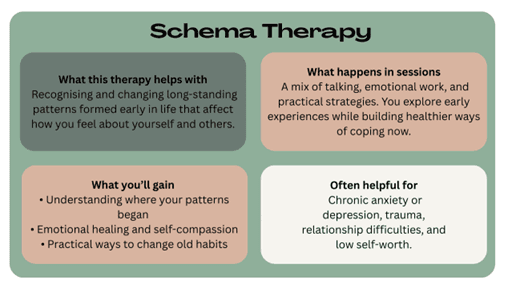
CBT is one of the most widely used and well-researched therapies, and it's often where people start. It looks at the links between your thoughts, feelings and behaviours, and how patterns in one can keep the others going.
The work is usually structured and practical, and it focuses on the present rather than spending most of its time on the past. Your psychologist might help you notice unhelpful thinking patterns, test them out, and build more helpful ways of responding. There's often something to practise between sessions.
CBT has strong evidence behind it for concerns like anxiety and depression, which is part of why it's so commonly recommended. If you like a clear structure and practical tools you can use in everyday life, this approach may suit you.
Psychodynamic Therapy
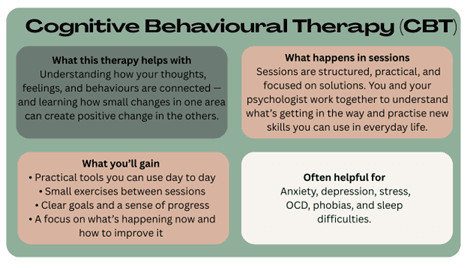
Psychodynamic therapy takes a longer view. It explores how your past experiences, early relationships and patterns you may not be fully aware of can shape how you feel and relate to people now.
Rather than focusing mainly on tools and techniques, this approach is about insight and understanding. The idea is that when you can see where a pattern comes from, it often loosens its grip. Sessions tend to be less structured, giving you space to talk openly and follow where things lead.
This style can be helpful if you keep running into the same difficulties in relationships or in how you feel about yourself, and you want to understand the deeper roots rather than just manage the symptoms.
Eye Movement Desensitisation and Reprocessing (EMDR)
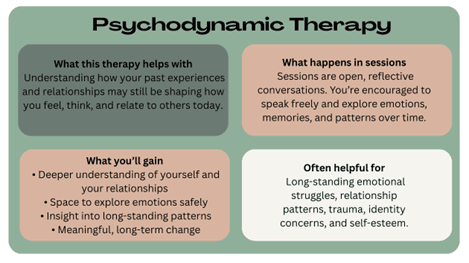
EMDR is a structured therapy that was developed to help people process distressing or traumatic memories. It's often used with trauma and post-traumatic stress.
During EMDR, you briefly bring to mind a difficult memory while following a back-and-forth movement, usually your therapist's hand or a set of lights, or sometimes gentle tapping. This is thought to help the brain reprocess the memory so it feels less vivid and distressing over time. You don't have to talk through every detail of what happened, which some people find more manageable.
EMDR follows a clear protocol and is delivered by trained clinicians. If past events still feel present or overwhelming, this is one approach worth asking about.
Schema Therapy
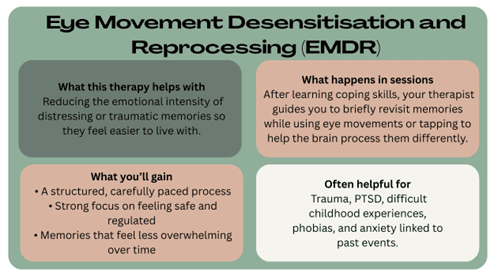
Schema therapy is designed for longstanding patterns that can feel like they're just part of who you are. It brings together ideas from CBT, attachment theory and psychodynamic therapy.
A schema is a deep pattern of thoughts, feelings and beliefs that often forms early in life, sometimes when core emotional needs weren't fully met. These patterns can quietly drive how we see ourselves and others well into adulthood. Schema therapy helps you recognise these patterns, understand where they came from, and gradually meet those needs in healthier ways.
Because it works at this deeper level, it's often used for more entrenched difficulties that haven't fully shifted with shorter-term approaches. It usually takes place over a longer period.
sche
Dialectical Behaviour Therapy (DBT)
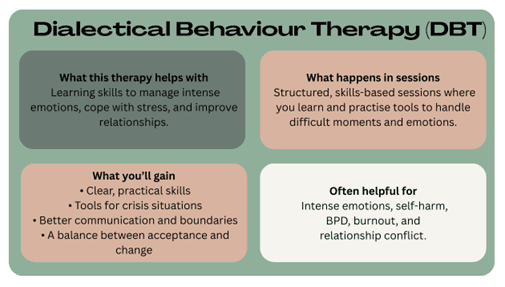
DBT was originally developed to support people who experience very intense emotions and find them hard to manage. It's built around a balance between accepting yourself as you are and working towards change.
DBT usually teaches four sets of skills: mindfulness, distress tolerance, emotion regulation, and interpersonal effectiveness. In plain terms, that's staying present, getting through hard moments without making things worse, understanding and managing strong feelings, and navigating relationships. These skills are practical and can be used in daily life.
This approach can be helpful for people who feel emotions strongly, struggle with impulsivity, or find relationships difficult. It's often delivered as a combination of individual sessions and skills practice.
Enhanced Cognitive Behavioural Therapy (CBT-E)
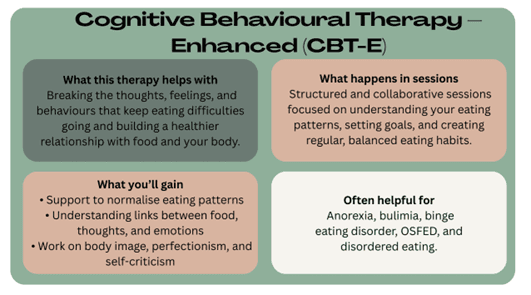
CBT-E is a specialised, evidence-based form of CBT developed specifically to treat eating disorders. The "E" stands for enhanced, reflecting that it's tailored to the particular difficulties that come with these conditions.
Like standard CBT, it's structured and collaborative, and it focuses on the patterns that keep a difficulty going. CBT-E is designed to be flexible so it can be adapted to a person's specific situation, and it's usually delivered by clinicians with training in eating disorder treatment.
If this is an area you're seeking support with, working with a psychologist who has experience in this space can make a real difference.
How do you know which therapy is right for you?
Here's the reassuring part: you don't need to figure this out on your own before you start. You don't have to pick a therapy type off a list. A big part of a psychologist's job is getting to know you and your situation, then drawing on the approaches that fit best, sometimes blending a few together.
What matters more than choosing the "perfect" method is finding a psychologist you feel comfortable with and who has experience in the areas you want support with. The relationship you build together is one of the biggest factors in whether therapy helps.
If you're not sure where to start, Pair can help you find and get in touch with a psychologist, including clinicians who work in these specific approaches, so support feels a little easier to reach.
Key takeaways
- There are many types of therapy, and each is designed to support different challenges.
- CBT is structured and practical, and it's often a first-line approach for anxiety and depression.
- Psychodynamic therapy explores how the past shapes the present and focuses on insight.
- EMDR is a structured approach often used to help process trauma.
- Schema therapy works with deep, longstanding patterns that formed early in life.
- DBT teaches practical skills for managing intense emotions and relationships.
- CBT-E is a specialised form of CBT for treating eating disorders.
- You don't have to choose an approach yourself. A good psychologist will guide this with you.